
From the Rainforest to the Andes: Meet Over 60 Tarantula Species in Ecuador
The post From the Rainforest to the Andes: Meet Over 60 Tarantula Species in Ecuador appeared first on A-Z Animals.
Quick Take
Arboreal tarantulas such as species in the Amazonius and Avicularia genera inhabit the Amazon rainforest.
Inaccurate type localities and inadequate historical descriptions render the genus Cyclosternum problematic.
Tapinauchenius montufari was discovered in the dry forests of the Jubones Valley, making it the first record of Tapinauchenius on the western slope of the Andes.
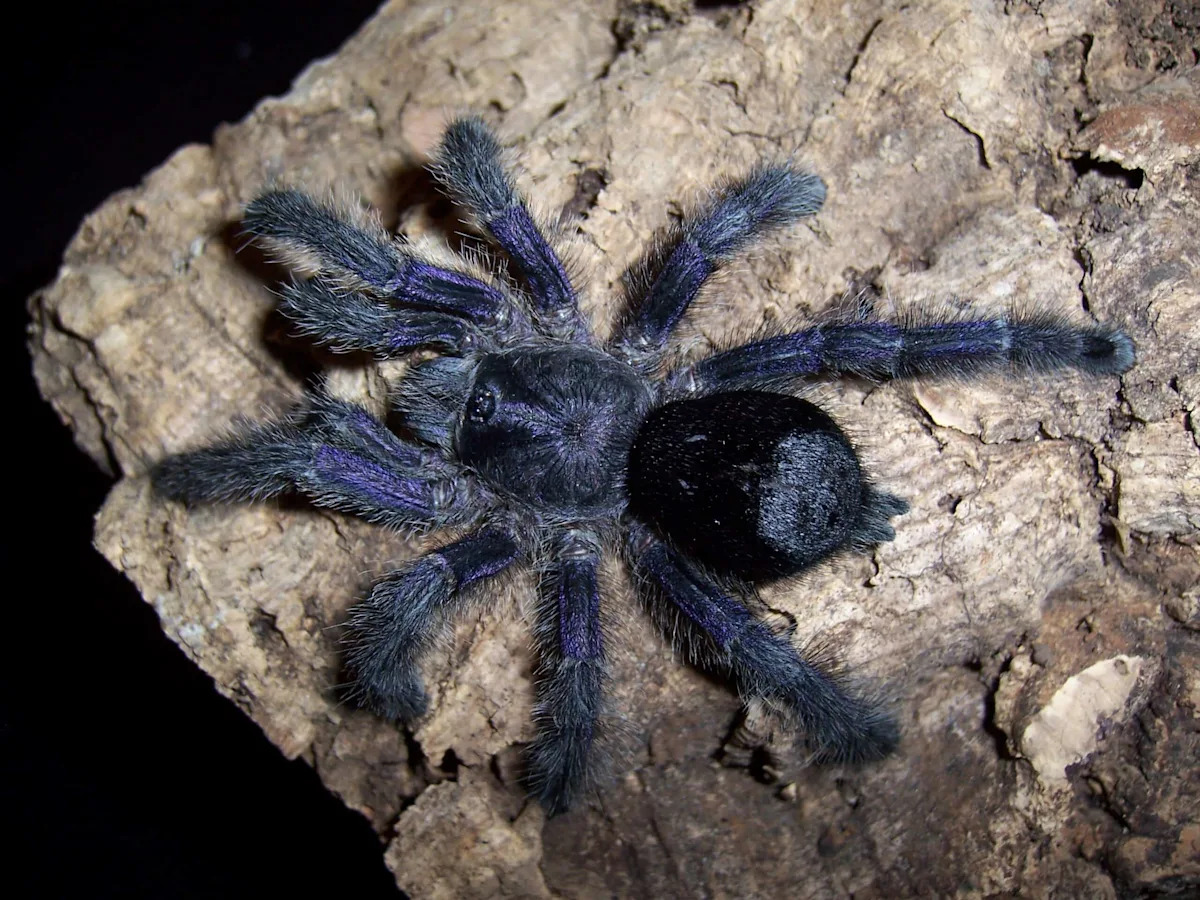
Extensive fieldwork remains necessary to verify the distribution of the elusive midnight blue Warmiru species.
Ecuador is located on South America’s west coast, bordering the Pacific Ocean at the equator. Geographically, the country is divided into four regions, including the Andean highlands, the Amazon, the Pacific coast, and the Galapagos Islands. There are over 60 known tarantula species in Ecuador, but researchers suspect there are more undescribed species, given the high number of endemic species in other spider groups and the country’s diverse ecological regions.
From nine-inch birdeaters to the mysterious ‘midnight blue’ species, Ecuador’s jungles are harboring giants that defy historical records. © A-Z Animals
The following list includes all currently recognized tarantula species in Ecuador according to the World Spider Catalog as of December 2025. An asterisk after the species name indicates that the tarantula is the type species for that genus. For a comprehensive reference of all tarantula species, see our complete list of tarantula species.
Amazonius Cifuentes & Bertani, 2022
Amazonius is a genus of arboreal tarantulas created to accommodate former Tapinauchenius species. A. elenae is known from Napo, Ecuador. This tarantula has a brown body with an abundance of long, pinkish-orange to brownish-orange setae on its legs and abdomen. Its cephalothorax has a golden olive sheen. When researchers transferred A. subcaeruleus to Amazonius, it was synonymized with Amazonius burgessi. This spider is generally dark colored and the cephalothorax, abdomen, and legs are densely covered in short, dark setae. Longer, lighter, reddish-colored setae are interspersed on the abdomen. Its legs are also covered in longer, lighter setae. These medium-sized spiders reach leg spans of up to around 5 inches.
Amazonius elenae* (Schmidt, 1994)
Common name: Ecuadorean tree spider or Ecuadorean orange
Distribution: Ecuador, Brazil
Amazonius subcaeruleus (Bauer & Antonelli, 1997)
Distribution: Colombia, Ecuador, Venezuela
Avicularia Lamarck, 1818
Tarantulas in the genus Avicularia are arboreal. In Ecuador, they are generally found in the Amazon rainforest and Andean foothills, inhabiting the leaves of plants, tree trunks, and tree cavities, using bark and other debris to camouflage their retreats. They are small to medium-sized spiders, with leg spans of 4-6 inches. Avicularia species have stout, type II urticating setae that are typically transferred by direct contact, not carried by the air as in most tarantulas. Most species have pale rings on the ends of their femora, tarsi, and metatarsi (the longest segment and the final two segments). All species also have abdominal color patterns that change significantly during development (except for A. minatrix). These patterns may be lost as adults. The legs and palps are covered in long guard-setae, while the abdominal setae are more evenly distributed in most species.

Avicularia hirschii Bullmer, Thierer-Lutz & Schmidt, 2006
Distribution: Ecuador, Peru, Brazil
Avicularia juruensis Mello-Leitão, 1923
Common name: Amazonian pinktoe or Peruvian pinktoe
Distribution: Colombia, Ecuador, Peru, Brazil
Avicularia lynnae Fukushima & Bertani, 2017
Distribution: Peru, Ecuador
Avicularia purpurea Kirk, 1990
Common name: Ecuadorian purple or Ecuador purple pinktoe
Distribution: Colombia, Ecuador, Peru
Avicularia rufa Schiapelli & Gerschman, 1945
Common name: Yellow-banded pinktoe
Distribution: Ecuador, Peru, Bolivia, Brazil
Crypticarachne Peñaherrera-R., Sherwood, Gabriel, León-E., Rollard, Leguin, Brescovit & Lucas, 2025
Crypticarachne is a recently described monotypic genus for the species Crypticarachne nadineae. C. nadineae was transferred from Thrixopelma due to a unique combination of genitalia morphology, tibial apophysis (protrusion) structure, and a strongly curved metatarsus I. Researchers also noted its small size in comparison with other Thrixopelma species. The holotype male has a total length of 0.95 inches, and its longest legs (pair IV) measure 1.57 inches. It has type III urticating setae on the top of its abdomen. Its overall color is brown due to preservation. This burrowing tarantula is known only from the type locality, Loja, Ecuador, located in the country’s southern Andean region.
Crypticarachne nadineae* Peñaherrera-R., Sherwood, Gabriel, León-E., Rollard, Leguin, Brescovit & Lucas, 2025
Cyclosternum Ausserer, 1871
Tarantulas in the genus Cyclosternum are generally small to medium-sized burrowing spiders that reach 4-5 inches in leg span. They are typically found in grasslands and forests in humid, tropical regions. However, species-level identification is difficult, and the genus is often considered problematic. Researchers note that not only does the genus need a complete revision, but the identity and distribution of Cyclosternum species in Ecuador are not well established. There are three species, C. gaujoni, C. janthinum, and C. schmardae, with overlapping distributions, and illustrations of C. gaujoni are considered invalid, as the female was never illustrated. Male descriptions and illustrations of C. schmardae are also considered doubtful.
Cyclosternum gaujoni Simon, 1889
Cyclosternum janthinum (Simon, 1889)
Cyclosternum matildeae (Peñaherrera-R., Sherwood, Gabriel & Ghia, 2024)
Cyclosternum schmardae Ausserer, 1871
Common name: Yellow-banded birdeater
Distribution: Colombia, Ecuador
Cyclosternum seldeni (Sherwood & Gabriel, 2023)
Cymbiapophysa Gabriel & Sherwood, 2020
Cymbiapophysa was established to accommodate Cymbiapophysa velox and Cymbiapophysa yimana, primarily based on the morphology of the male and female reproductive organs. It is a diverse genus with short geographical ranges and elevations. They can generally be found from around 40 feet to 9,137 feet in the western mountain range of the Andean cordillera of Ecuador and the Western Cordillera of Colombia, which are considered key biodiversity hotspots. Cymbiapophysa includes small to medium-sized burrowing spiders with a total body length between 0.75 inches and 1.50 inches. Little is known about the biology of individual species, as most are known only from historical museum specimens.
Cymbiapophysa ashily Ghia, Peñaherrera-R., Sherwood & Gabriel, 2024
Cymbiapophysa bettycita Peñaherrera-R. & Ghia, 2025
Cymbiapophysa carmencita Peñaherrera-R., 2023
Cymbiapophysa falconi Peñaherrera-R., 2023
Cymbiapophysa homeroi Peñaherrera-R., 2023
Cymbiapophysa otongachi Peñaherrera-R., Ghia, Sherwood & Gabriel, 2024
Cymbiapophysa velox* (Pocock, 1903)
Common name: Ecuadorean dwarf
Cymbiapophysa yimana Gabriel & Sherwood, 2020
Distribution: Peru or Ecuador
Cymbiapophysa yumbos Peñaherrera-R., Ghia, Sherwood & Gabriel, 2024
Hapalopus Ausserer, 1875
Hapalopus tarantulas are distinguished by the spotted abdominal patterns on the sides, top, and/or underside, sometimes also with speckling or stripes on the sides. These spiders are commonly called “pumpkin patch tarantulas” because their patterns are often in shades of black and orange. These small terrestrial tarantulas have semi-arboreal tendencies and can be found in both tropical, dry forests and montane regions. H. planetearth has a grey body with a black and orange starburst pattern on the carapace and a black and orange pattern on the abdomen said to look like a crown. This spider’s chelicerae (mouthparts) are also orange, and it is covered in long, pale setae on its legs and abdomen. H. planetearth is known from the Amazon region, specifically Sucumbíos Province in northeast Ecuador.

Hapalopus planetearth is called the Ecuador crowned tarantula for the pattern on its abdomen.
©Dr Morley Read/Shutterstock.com
(Dr Morley Read/Shutterstock.com)
Hapalopus planetearth Dupérré & Tapia, 2025
Common name: Ecuadorian crowned tarantula
Holothele Karsch, 1879
Holothele tarantulas are generally small burrowing spiders with leg spans of 3-4 inches. These spiders can also be distinguished by the absence of urticating setae. They are also known to excavate extensive, heavily webbed burrows. In fact, the genus was initially part of the family Dipluridae, or curtain-web spiders, before being transferred to the family Theraphosidae in 1980. H. incurva and H. tsala are recently described species from Napo province.
Holothele incurva Dupérré & Tapia, 2025
Holothele tsala Dupérré & Tapia, 2025
Megaphobema Pocock, 1901
Megaphobema species are large tarantulas with a leg span between 6 and 8 inches. M. velvetosoma females appear a velvety brown color, while males are more blackish-brown. They have long, bright reddish setae on the abdomen and long, pale setae on their legs. The original description of the genus notes that legs III and IV are longer and stronger than legs I and II. This burrowing tarantula is found in the Amazon rainforest region of Ecuador.

Megaphobema velvetosoma Schmidt, 1995
Common name: Ecuadorian brown velvet tarantula
Distribution: Ecuador, Peru, Brazil
Neischnocolus Petrunkevitch, 1925
Neischnocolus can be differentiated from nearly all other genera by the complex morphology of their reproductive organs and the presence of subtype Id urticating setae, which are unusually long. They are small burrowing tarantulas that are generally brown or reddish-brown in color. These spiders have short, reddish-brown or dark brown setae on their legs, and some species also have light-colored banding. Their abdomens are dark with long reddish setae on the top and sides, and some species may have light abdominal patterns. Neischnocolus tarantulas are found on the eastern and western sides of the Andean slopes.
Neischnocolus ballerioi Dupérré & Tapia, 2025
Neischnocolus canosita Dupérré & Tapia, 2025
Neischnocolus cisnerosi Peñaherrera-R., Guerrero-Campoverde, León-E., Pinos-Sánchez & Falcón-Reibán, 2023
Neischnocolus moraspungo Cisneros-Heredia, Peñaherrera-R., Guerrero-Campoverde, León-E. & Gabriel & Sherwood, 2025
Neischnocolus pampenita Dupérré & Tapia, 2025
Neischnocolus ruffoi Dupérré & Tapia, 2025
Neischnocolus samonellaacademy Peñaherrera-R., León-E., Guerrero-Campoverde, Gabriel, Sherwood & Cisneros-Heredia, 2025
Neischnocolus tiputini Guerrero-Campoverde, Peñaherrera-R., León-E., Gabriel, Sherwood & Cisneros-Heredia, 2025
Neischnocolus tsere Peñaherrera-R., Guerrero-Campoverde, León-E., Pinos-Sánchez & Falcón-Reibán, 2023
Neischnocolus yupanquii (Pérez-Miles, Gabriel & Gallon, 2008)
Pamphobeteus Pocock, 1901
Pamphobeteus spiders are medium to very large terrestrial tarantulas. They have a body size of up to 3.78 inches and a leg span of up to 9 inches. Researchers note that many Pamphobeteus specimens have dark bodies with colored markings on either side of the cephalic region (head). These markings, typically in pink or purple, may be linked to radial striations on the cephalothorax. They may also have longitudinal striping on their legs. However, in some species, there is sexual dimorphism in relation to color. Their abdomens are covered with long setae, as well as type I urticating setae. Pamphobeteus species prefer forested regions, including Ecuadorean wet and dry forests, Napo moist forests, and Eastern Cordillera Real montane forests.

Pamphobeteus ultramarinus is known as the Ecuadorean birdeater.
©Angela N Perryman/Shutterstock.com
(Angela N Perryman/Shutterstock.com)
Pamphobeteus augusti (Simon, 1889)
Pamphobeteus contramina Dupérré & Tapia, 2025
Pamphobeteus gangotenai Cisneros-Heredia, Peñaherrera-R., León-E., Sherwood, Gabriel, Brescovit & Lucas, 2023
Pamphobeteus guacamayos Dupérré & Tapia, 2025
Pamphobeteus jamacoaque Peñaherrera-R., Cisneros-Heredia, León-E., Sherwood, Gabriel, Brescovit & Lucas, 2023
Pamphobeteus lasjuntas Peñaherrera-R., Cisneros-Heredia, León-E., Sherwood, Gabriel, Brescovit & Lucas, 2023
Pamphobeteus matildeae Sherwood, Gabriel, Peñaherrera-R., Cisneros-Heredia, León-E., Brescovit & Lucas, 2023
Pamphobeteus nellieblyae Sherwood, Gabriel, Brescovit & Lucas, 2022
Pamphobeteus skis León-E., Peñaherrera-R., Cisneros-Heredia, Sherwood, Gabriel, Brescovit & Lucas, 2023
Pamphobeteus ultramarinus Schmidt, 1995
Common name: Ecuadorean birdeater
Pamphobeteus urvinae Sherwood, Gabriel, Brescovit & Lucas, 2022
Pamphobeteus vespertinus (Simon, 1889)
Pamphobeteus zaruma Sherwood, Gabriel, Brescovit & Lucas, 2022
Psalmopoeus Pocock, 1895
Tarantulas in the genus Psalmopoeus are arboreal. They differ from other genera by the single row of firm stridulatory setae on their mouthparts and the absence of urticating setae. Psalmopoeus species are medium to large spiders with leg spans of 5-7 inches, although some may grow larger. Species in this genus often have dark bodies with metallic coloration on the legs and carapace and/or chevron-like abdominal patterns. These spiders generally build tube webs in tree hollows, under loose tree bark, and among dense vegetation. In Ecuador, these tarantulas inhabit low montane forests and the evergreen forests in the Cordillera Occidental of the Andes. They have been found in the provinces of Cotopaxi, Santo Domingo de Los Tsachilas, Pichincha, and Manabí.
Psalmopoeus chronoarachne Peñaherrera-R. & León-E., 2023
Psalmopoeus ecclesiasticus Pocock, 1903
Common name: Ecuadorian olive tree spider
Psalmopoeus pristirana Dupérré & Tapia, 2024
Psalmopoeus satanas Peñaherrera-R. & León-E., 2023
Pululahua Dupérré & Tapia, 2025
Pululahua species are small, terrestrial tarantulas, primarily distinguished by the structure of the palpal tibia and tibial apophysis in leg I in males, the morphology of their genitalia, and the absence of urticating setae. P. kunuyaku was collected in the Pululahua Geobotanical Reserve, Pichincha province. It was found in the evergreen forest of the Western Cordillera at an elevation of 6,981 feet. The male holotype has a total length of 0.34 inches, and its longest legs (pair IV) measure 0.58 inches. Its body and legs are dark brown. The carapace is densely covered in gold setae, while the abdomen and legs are covered in brown setae. P. winku was collected in the low montane evergreen forest of the western side of the Andes. Its distribution is Cotopaxi and Pichincha Provinces. P. winku has a total length of 0.33 inches, and its longest legs (pair IV) measure 0.59 inches.
Pululahua kunukyaku* Dupérré & Tapia, 2025
Pululahua winku Dupérré & Tapia, 2025
Reversopelma Schmidt, 2001
The genus Reversopelma consists of small to medium-sized burrowing tarantulas. It is primarily differentiated by the presence of unique aspects in the male’s genitalia, the morphology of their reproductive organs, and urticating setae type I in both sexes. R. petersi was originally collected from the Amazonian lowlands along the Pastaza River in either Ecuador or Peru. The female is described as having a light brown cephalothorax and a black abdomen, while the male is said to be darker overall. R. spinometatarsi was collected near Tiputini Biodiversity Station in Orellana Province, Ecuador. Its name refers to the small, coarse spines on metatarsus I that distinguish the species. This spider is shades of brown, with a darker brown carapace and femora. The joints have pale, peachy-orange colored bands. The abdomen is brown with longer reddish setae.
Reversopelma petersi* Schmidt, 2001
Distribution: Ecuador or Peru
Reversopelma spinometatarsi Peñaherrera-R., Mora-Bolaños, Guerrero-Campoverde, León-E., Ríos-Tamayo, Gabriel, Sherwood & Cisneros-Heredia, 2025
Romopelma Peñaherrera-R., Pinos-Sanchez, Guerrero-Campoverde, León-E. & Cisneros-Heredia, 2024
Romopelma is a monotypic genus, including only Romopelma barrigae. The genus is primarily diagnosed by the morphology of the male reproductive organ, urticating setae type I on the abdomen, and no tibial apophysis. R. barrigae is a small, terrestrial tarantula with a total length of 0.56 inches. Its longest legs (pair IV) measure 1.42 inches. Its preserved color is brown, but there is no information about its coloration in life. This spider was originally collected at an elevation of around 4,100 feet in the valley of Mindo, Pichincha province in the Western Cordillera of the Andes in northwestern Ecuador. The area is characterized by low montane evergreen forest.
Romopelma barrigae* Peñaherrera-R., Pinos-Sanchez, Guerrero-Campoverde, León-E. & Cisneros-Heredia, 2024
Tandayarachne Peñaherrera-R. & Guayasamin, 2025
Tandayarachne is a recently described genus created for the newly discovered species Tandayarachne sherwoodae. The genus was named for the Tandayapa Cloud Forest Station in the Andes of the Pichincha Province in western Ecuador where the new species was found. This montane genus is found at elevations from around 5,500 feet in the lower valley to over 7,500 feet in the upper regions. An image shared by one of the study’s authors shows T. sherwoodae has a brown body with dark, metallic red in the cephalic (head) area with reddish striations on the carapace. It has lighter red setae around the carapace edges. The spider has short, dense, dark red setae on the femora, and the legs and abdomen are covered in an abundance of lighter red setae. Its feet are covered in greyish-brown setae.
Tandayarachne sherwoodae* Peñaherrera-R. & Guayasamin, 2025
Tapinauchenius Ausserer, 1871
Tarantulas in the arboreal genus Tapinauchenius are medium-sized spiders, generally reaching leg spans of 4-5 inches. These spiders lack both urticating setae and stridulatory, or noise-making, organs. They are typically found in tree hollows or under loose tree bark in humid forests and rainforests. T. cupreus is found in the northern Amazon region. T. dayuma inhabits the rainforests of Orellana province. T. montufari was discovered in the southwestern foothills of the Andes, in the dry forests of the Jubones Valley, in Azuay province. It is the first record of Tapinauchenius on the western slope of the Andes. Adult Tapinauchenius spiders are often shades of brown to black with a silky, golden metallic sheen and longer, reddish setae on their legs and abdomens.

Tapinauchenius cupreus Schmidt & Bauer, 1996
Common name: Violet tree spider
Tapinauchenius dayuma Peñaherrera-R., Guerrero-Campoverde, León-E., Falcón-Reibán, Fajardo-Torres, Picón-Rentería, Gabriel, Sherwood & Cisneros-Heredia, 2025
Tapinauchenius montufari Peñaherrera-R., Guerrero-Campoverde, León-E., Falcón-Reibán, Fajardo-Torres, Picón-Rentería, Gabriel, Sherwood & Cisneros-Heredia, 2025
Thalerommata Ausserer, 1875
In 2023, researchers transferred the genus Thalerommata from the brushed trapdoor spider family, Barychelidae, to Theraphosidae. Tarantulas in the Thalerommata genus are very small arboreal spiders that typically have leg spans of 2 inches or less. They are differentiated from other genera by the presence of flat, iridescent setae on the abdomen and sometimes legs. T. yasumi is known from the Yasuní National Park, Orellana Province, which is in the Amazon region in eastern Ecuador.
Thalerommata yasuni Dupérré & Tapia, 2025
Thrixopelma Schmidt, 1994
Researchers describe Thrixopelma as medium to large burrowing spiders with a body length between 1.38 inches and 2.36 inches. Urticating setae type III or III+IV on the abdomen, the morphology of the genitalia, and the palpal tibia with retrolateral domed or triangular protrusions in males distinguish this genus. Females have also been recorded to have a longitudinal dark stripe on the abdomen. T. supay is known from Loja in southern Ecuador. Live specimens have grey to black bodies with darker femora, light-colored bands at the joints, orange longitudinal stripes on the patellae, and long setae on the legs and abdomen. T. michaeli is known from the tepuis (flat-top mountains) in Nangaritza Valley, Zamora Chinchipe Province. Its overall color is brown as a result of preservation, but there is evidence of darker leg segments and banding at the leg joints, as well as long setae on the legs and abdomen.
Thrixopelma michaeli Dupérré & Tapia, 2025
Thrixopelma supay Dupérré & Tapia, 2025
Warmiru Peñaherrera-R., Sherwood, Gabriel, León-E., Rollard, Leguin, Brescovit & Lucas, 2025
Warmiru is a newly described genus established in 2025 to house species previously in Thrixopelma. They differ from Thrixopelma in the morphology of male and female genitalia and the absence of a dark longitudinal stripe on the abdomen of females. Like Thrixopelma species, the members of genus Warmiru are medium to large-sized spiders. Warmiru longicolli is shades of grey blue to midnight blue, with brighter colors after molting. They have darker femora, light-colored longitudinal stripes on their legs, and long, light greyish-blue setae on their legs and abdomen. Researchers note that further fieldwork is required to determine the accurate distribution of this species.
Warmiru longicolli (Schmidt, 2003)
Common name: Peruvian blue zebra, midnight blue birdeater
Distribution: Ecuador or Peru
The post From the Rainforest to the Andes: Meet Over 60 Tarantula Species in Ecuador appeared first on A-Z Animals.
