
What shattered Crystal Jade? How the culinary empire shrank from 120 to just 9 outlets
Some experts believe its expansion was overdone, others cite the midmarket squeeze Read more at The Business Times.
Some experts believe its expansion was overdone, others cite the midmarket squeeze
[SINGAPORE] At its peak in 2015, Crystal Jade operated a sprawling global network of 120 restaurants, with 47 locations anchoring its presence in Singapore.
Today, the home-grown institution has retreated to just nine operating restaurants locally. Its central kitchen is shuttered and its holding companies are in receivership.
Last month, four outlets – three Crystal Jade La Mian Xiao Long Bao restaurants at Bugis Junction, Toa Payoh and i12 Katong, as well as Crystal Jade GO at Oasis Terraces in Punggol – ceased operations, retrenching around 120 workers.
What led to this dramatic contraction for a brand that used to witness long queues and once commanded a US$100 million private equity buyout? The Business Times traces Crystal Jade’s origins, what missteps may have led to its current distress and what is left in store for the brand.
Rise of the culinary empire
The origins of Crystal Jade date back to 1991, beginning as a singular Cantonese fine-dining restaurant in Singapore’s now-demolished Cairnhill Hotel. The venture initially struggled to gain traction, teetering on insolvency by its second year.
But its turning point came that same year, when Hong Kong-born entrepreneur Ip Yiu Tung injected S$2 million to secure a 49 per cent controlling stake in the ailing business.
THE BUSINESS TIMES INSIGHTS
Powering Asean's Future 2026
Find out how enterprises are navigating power constraints and sustainability targets
ACCESS THE INSIGHTS
Under Ip’s stewardship, the brand began a lucrative expansion into the mass-market segment with the launch of Crystal Jade Kitchen, moving away from a purely fine-dining Cantonese concept.
The new strategy transformed the once-struggling restaurant into a highly scalable holding company, generating an estimated S$240 million in annual turnover by 2009.
It soon attracted global institutional investors. In 2014, L Capital Asia (subsequently merged to form L Catterton) acquired a majority stake, valuing the enterprise at about US$100 million. L Capital Asia was a consumer PE firm set up in 2009 and sponsored by LVMH.
SEE ALSO
The complexity multiplier
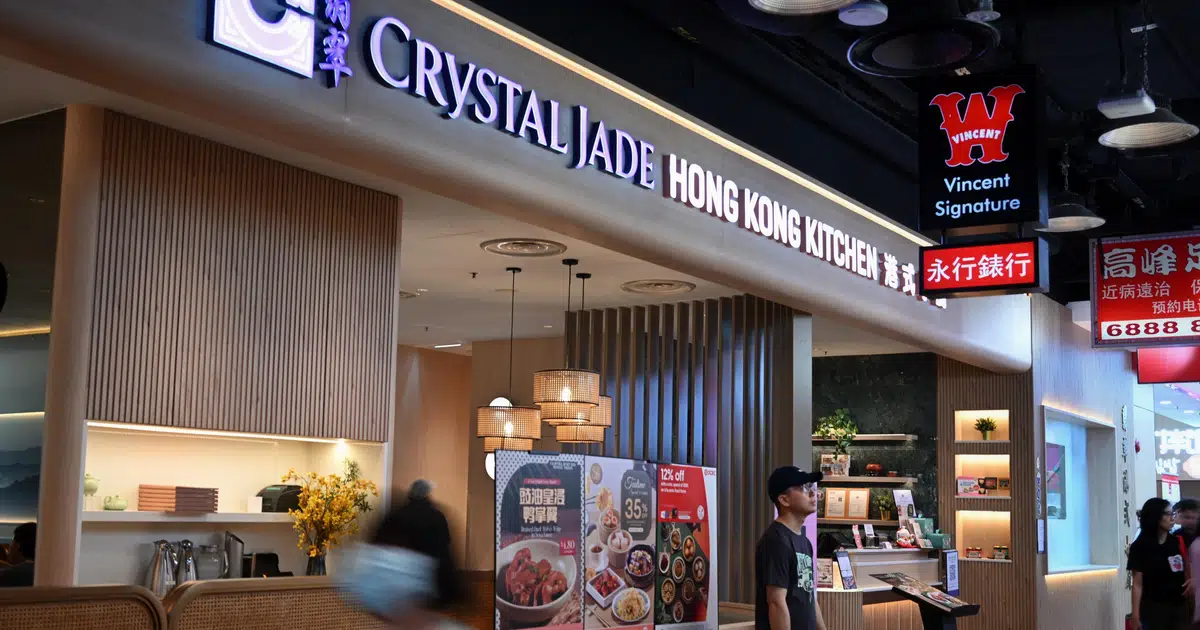
Following the private equity buyout, the group’s portfolio was segmented into distinct categories: prestige fine dining anchored by concepts such as Crystal Jade Golden Palace, mid-tier casual dining such as Crystal Jade La Mian Xiao Long Bao, family-oriented Hong Kong Kitchen, and quick-service takeaway models under the CJ GO and My Bread banners.
While Crystal Jade is privately held, and neither its financial positions nor debt structure are publicly disclosed, some experts believe this expansion may have stretched Crystal Jade thin.
Geoffrey Tai, manager of lifestyle and consumer experience at Temasek Polytechnic, said that prior to L Capital Asia’s involvement, Crystal Jade originally had a clear structure.
Fine dining built its reputation, casual dining brought in customer volume, and its central kitchen helped maintain consistency while keeping costs under control, he said.
The aim was to aggressively replicate this operational density across multiple markets and dining tiers. But scaling the business became a “complexity multiplier”, Tai suggested.
“Expanding into fine dining, mid-tier casual and quick-service simultaneously across multiple geographies stretched management thin and forced the brand to compete in segments where its heritage equity bought it nothing,” he said.
Crystal Jade has the foundation of a strong brand reputation, but Tai emphasised that long-term success ultimately depends on understanding local consumers, maintaining a clear value proposition and adapting to market conditions.
“The real error was not deepening the moat in Singapore, where the brand was strongest, but spreading it thin across price tiers that cannibalised each other,” Tai added, noting the brand should have fortified its core competitive advantage rather than diluting it.
Geng Xuesong, associate professor of strategic management at Lee Kong Chian School of Business, Singapore Management University, said that there were strengths to the expansion strategy, but it was plausible that the operational complexity grew faster than the underlying restaurant unit economics and organisational capabilities.
“The managerial complexity would increase tremendously, particularly for new expansion like CJ GO, because its operations might require very different management and organisational capabilities from those Crystal Jade has built in other outlets,” he said.
Tai suggested that Crystal Jade’s portfolio was broad but not deep: premium outlets lacked exclusivity to command fine-dining margins, mid-tier outlets lacked differentiation, and quick-service outlets lacked the cost structure to win on price.
“In short, margin compression hit every tier at once,” he said.
L Catterton declined to comment on the strategy.
Squeezed middle
Simultaneously, the brand’s mid-tier segments found themselves caught in an increasingly polarised domestic dining scene.
“Premium dining thrives because they sell a special night out you can’t replicate at home, while casual dining thrives on pure speed and value. The middle is in trouble because it asks people to pay a 30 to 50 per cent premium over hawker food, without offering any of the ‘wow factor’ of fine dining,” Tai explained.
“Brands that are merely familiar, rather than distinctive, are particularly vulnerable,” Prof Geng said of the wider F&B field.
Sherri Kimes, an emeritus professor of operations management at Cornell University, said that midmarket restaurants can also struggle when their prices rise without a corresponding increase in perceived value.
“Whether that happened at Crystal Jade would require additional evidence,” she said.
Tai, on the other hand, was more convinced of the squeezed middle’s impact.
“In my view, that’s where Crystal Jade’s mid-tier got trapped – not cheap enough to compete on value, not unique enough to feel like a treat.
“Crystal Jade is just the most obvious example of what happens when a mid-tier Chinese restaurant gets stuck in no-man’s-land,” he said.
The crystal shatters
The company’s physical footprint began fracturing in 2026.
After quietly shuttering underperforming branches earlier in the year, the group contracted further in September and October, closing multiple mass-market and mid-tier outlets across Singapore and retrenching about 120 workers.
This was accompanied by the permanent closure of Crystal Jade Food Manufacturing, the group’s centralised kitchen.
Financial and risk advisory firm Kroll was appointed as receivers over Crystal Jade’s holding companies in Singapore and Hong Kong.
Keith Han, head of restructuring and insolvency at Bazul, explained that despite the receivership, the holding companies and the restaurants will continue to operate normally.
This legal move is understood as a way to facilitate L Catterton’s eventual exit from the brand. The private equity firm, Crystal Jade and Kroll declined to comment on the sale prospects.
Han noted that with the receivership in place, Kroll has the authority to sell off relevant assets to a prospective buyer without needing shareholder approval.
While details of the sale remain largely speculative, academics agreed that upon the sale, the incoming owner should execute some strategic pivots.
Prof Geng emphasised that the first priority should be to decide on the brand’s distinctive factor, rather than rely on the Crystal Jade name familiarity.
He noted his faith in its revival: “Crystal Jade is a valuable brand and heritage in Singapore, and it can be saved and revived if the new buyer can find out the sweet spot of how to utilise it in the right position and right portfolio.”
Originally published by businesstimes.com.sg. Syndicated material does not necessarily reflect the views of Glamour Canada.