
L.A.’s defense industry is booming. Federal funding crunch could change that
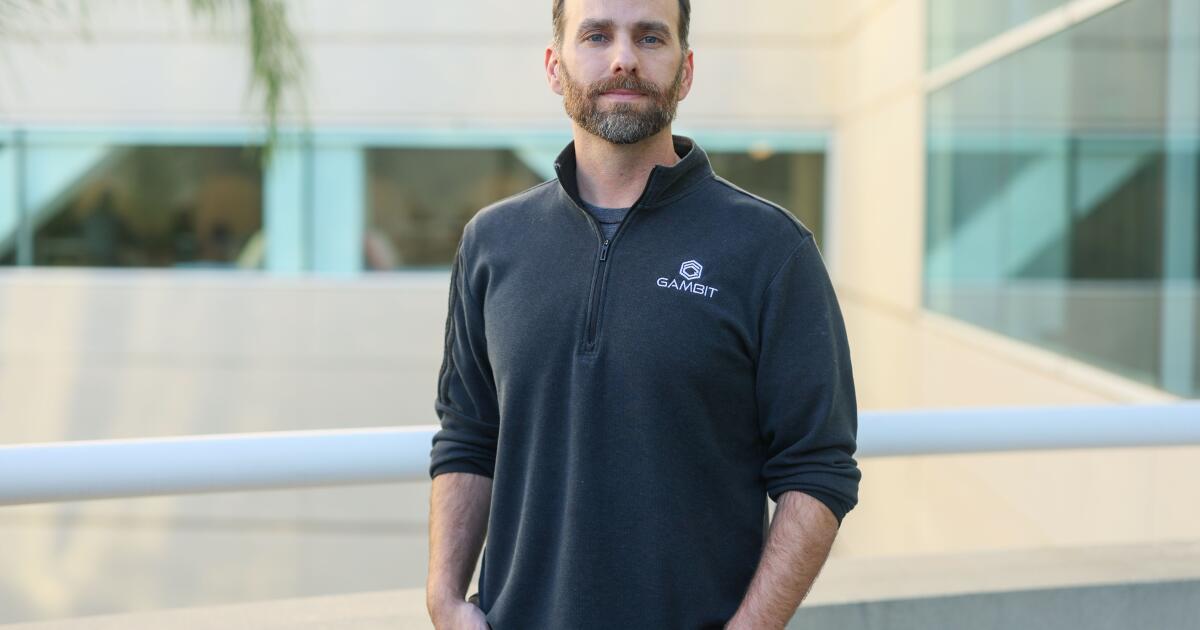
When former Space X engineer Josh Giegel launched his North Hollywood tech company Gambit in 2023, he had a vision for the battlefield of the future, one with fewer soldiers and more AI-driven assets.
His software would allow unmanned tanks and swarms of armed drones to communicate and adapt in real time — without human intervention.
The company now employs more than a dozen people and has contracts with the military, which is testing his software. But its growth has been clouded because of a funding dispute on Capitol Hill over the Small Business Innovation Research (SBIR) program, which provides companies seed capital to develop new technology that can assist the government. Funding for it and related programs expired in September.
The seed fund has been vital to many local tech startups. Gambit received $3.3 million from the program early on and was hoping to get another $5 million of the Small Business Administration money, which is allocated by the military.
Workers at K2 Space in Torrance, where the startup is building high-capacity satellites for Medium Earth Orbit. (K2 Space)
(K2 Space)
“That funding really helps companies like ours that are putting tech into warfighters’ hands,” Giegel said. “Losing that money becomes more leg work to find other sources.”
Gambit’s predicament is widely shared across Southern California, which has experienced a proliferation of tech startups launched by SpaceX alumni and other entrepreneurs with the support of SBA money.
In 2024, 124 contracts worth $173 million were awarded to 71 California companies through SpaceWERX, an El Segundo-based arm of the Space Force that distributes SBA funding to innovative defense startups.
The money also is disbursed by other branches of the military and departments of the government, which do not take stakes in the companies. Gambit received funds through the Air Force.
Other local recipients of SBA funding include Costa Mesa autonomous weapons maker Anduril Industries, now valued at more than $30 billion; and satellite platform manufacturers K2 Space in Torrance and Apex Space in Los Angeles.
The funds are allocated in phases, with initial feasibility awards up to about $300,000 and as much as $2 million for the development of prototypes. A maximum of $15 million is available through a companion SBA-funded program if the companies can bring in other funding.
“I don’t know if I can name a single company that I work with, or that I know of, that did not start with SBIR” funding, said Maggie Gray, a partner at Silicon Valley venture capital firm Shield Capital, which invested in Apex. “We see SBIR as a crucial part of the defense-tech ecosystem. It’s kind of the way to get your initial foot in the door with the government.”
Established in 1982, the SBA program provides more than $4 billion to government departments, with the military receiving the lion’s share. But SBA funding ran out on Sept. 30 as lawmakers clashed over proposed reforms.
Sen. Joni Ernst (R-Iowa), who chairs the Senate Committee on Small Business and Entrepreneurship, introduced a bill that would set a $75-million lifetime cap on funds for individual companies and establish performance benchmarks. The bill also would beef up due diligence to prevent new technology falling into the hands of foreign adversaries and end diversity, equity and inclusion preferences in funds distribution.
The legislation, however, has faced stiff opposition from Massachusetts Sen. Ed Markey, the ranking Democrat on the committee, who contends the reforms go overboard and would crimp innovation. A bipartisan House bill that would have reauthorized SBA funding for a year failed in the Senate amid opposition by Ernst, who is leaving Congress in a year.
While negotiations have restarted on Capitol Hill, there is no guarantee SBA financing will be restored, though the military and other government agencies could fund startups through their own budgets.
The SpaceWERX program, which has played a critical role in Southern California’s resurgent space economy, was established in 2020, just one year after the Space Force was founded.
Director Arthur Grijalva said the program distributes several hundred million dollars in SBA funding annually across the nation and has not had an issue with foreign influence or companies receiving repeat awards without much to show for it.
“Even though it might be small [funding] for a really big company, it’s really impactful for these small companies, these startups, where if they don’t have this funding, they might have to do layoffs, they might have to go into debt, or they might ultimately not be successful,” Grijalva said.
Since September, $94 million in larger contracts has been held up for more than 25 companies, which follow funding for feasibility studies and prototypes, according to SpaceWERX.
The impasse comes at an inopportune time for the Trump administration, which has been overhauling weapons procurement.
Secretary of Defense Pete Hegseth announced in November a policy to speed up weapons development by first finding capabilities in the commercial market before the government attempts to develop new systems. Last week he visited several L.A.-area defense companies, including Torrance startup Castelion, a manufacture of hypersonic missiles that received SBIR funding.
Kirsten Bartok Touw, managing partner of New Vista Capital, which invested in Castelion, agreed the program may have flaws but said it plays an invaluable role in attracting venture capital to companies that have drawn the funding.
“That is an important signal to the market, which says, ‘You should invest in more of these, because this is a technology we want and need,’” she said.
A report this month by the National Academies of Sciences, Engineering and Medicine found that one dollar of the funding distributed by the military attracts more than four dollars of venture capital or other third-party investment.
Markey’s office said last week he submitted a proposal to Ernst that includes making the SBIR program permanent, increased allocations, a performance metric, foreign due diligence standards and fellowships for underserved small businesses, among other provisions.
“This bill is [his] second attempt at breaking the logjam and restarting these critical programs to ensure America’s most nimble allies — small businesses — are not decimated,” a Markey spokesperson said.
A spokesperson for Ernst said last week that the senator “remains focused on ensuring taxpayer investments in R&D do not benefit China and actually deliver cutting-edge technology for our warfighters.”
Giegel said that while he is optimistic future SBA funding might come through for Gambit, he is not counting on it. He now assumes he will have to look for other sources of money to grow the company, which already attracted undisclosed venture capital.
“We’re trying to find operational relevance faster,” he said.