
Three new F-35 jets arrive in Israel, air force fleet grows to 48 aircraft
These three aircraft are part of a long-standing deal spread over a period of years to raise Israel’s fleet from 25 to 50 F-35s.
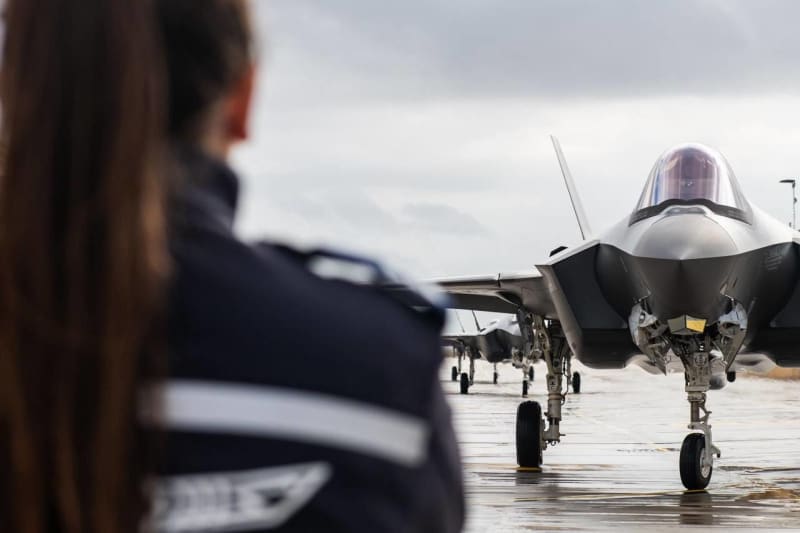
The IDF announced on Sunday that three F-35i aircraft have landed at Nevatim Air Force Base, purchased from US defense giant Lockheed Martin, which increases Israel’s quantity of F-35 aircraft to 48 out of 50, which are already fully purchased.
These three aircraft are part of a long-standing deal spread over a period of years to raise Israel’s fleet from 25 to 50 F-35s.
These aircraft were originally due in late 2025, but were delayed, with the last two aircraft still due to be delivered later in 2026.
But that is not the end of F-35 deliveries.
In 2023, Israel, the US government, and Lockheed Martin signed a deal for 25 additional F-35s, to eventually raise the number of aircraft to 75, which would mean a third squadron. Additional steps in that process took place in mid-2024.
The IDF receives additional F-35 fighter jets at the Nevatim Air Force Base. January 18, 2026. (credit: IDF SPOKESPERSON’S UNIT)
Third squadron of F-35s to come to Israel in 2027
Previously, The Jerusalem Post was told that the first third squadron F-35 deliveries would start in 2027.
Israel signed on to the F-35 program in 2010, and its F-35 program became operational in 2017.
By early 2025, the F-35 had already undertaken over 15,000 flight hours on all fronts of the war, which Israel was coping with, from Iran to Yemen to Syria to Lebanon to Gaza.
More specifically, the F-35 was Israel’s key first component in eliminating Iran’s best radars and air defenses in three rounds of attacks, including in the June 2025 Israel-Iran War.
In addition, over the course of the war, the IDF said it modified its F-35 aircraft to fire JDAM munitions from its wings, rather than its original design of dropping munitions from the aircraft’s belly.
Even before the war, the F-35 was considered crucial in the MABAM “war between wars” against Iranian proxies in Syria.
It has stealth technology, which makes it more able to strike targets throughout the Middle East with impunity, and its surveillance and intelligence capabilities far exceed Israel’s older F-16 and F-15 aircraft.
For example, it is said to be easily capable of outwitting Iran’s S-300 anti-aircraft missile defense system, and possibly even the S-400 system, whereas other Israeli aircraft would have more trouble.
Lockheed Martin Israel former CEO Joshua (Shiki) Shani has previously said, “We are proud to support the Israel Defense Forces in providing the F-35, and honored that the Israeli government has announced its intent to purchase additional F-35s.
“The Israel Air Force has proven its capabilities in critical operations with the 116 and 140 Squadrons, and we are looking forward to building on this strong performance. With a combination of stealth, sensor fusion, and electronic warfare, the fifth-generation F-35 will ensure the Israel Air Force stays ahead of current and evolving threats,” he said.
At the same time, Israel has moved forward on some parallel advancements and investments in the air force’s future.
After years of delay, the Defense Ministry has been moving forward with 25 F-15EX Boeing fighters from the US to help replace its aging F-15 aircraft.
In November 2022, Israel finalized an agreement to purchase four Boeing KC-46A midair-refueling aircraft.
Each of those new aircraft elements is also some years from being delivered to Israel, but would also eventually boost Jerusalem’s capability for attacking Tehran’s nuclear program, if needed.
