
Why the Birth of Three Andean Condors Represents a Second Chance for the Species
The post Why the Birth of Three Andean Condors Represents a Second Chance for the Species appeared first on A-Z Animals.
Quick Take
Three Andean condors hatched via artificial incubation increased the Colombian population by 4.5%.
Puppet feeding ensured the hatchlings did not come into contact with people, enabling them to develop a healthy fear of people, which is key to their survival.
It took 12 years for artificial incubation to succeed in Colombia.
Andean condors were once targeted due to the belief that they were killing livestock, but camera traps proved that protection dogs, foxes, and ocelots were the culprits.
The Andean condor has been threatened with extinction for decades. At one time, the condor was considered extinct in Venezuela, with populations in other South American countries not far behind. Thanks to conservation efforts and education, some populations have stabilized. Others, like in Colombia, are continuing to grow. This is, in part, thanks to three condor chicks that hatched in a conservation program that will soon be released and hopefully bring the next generation of Andean condors into the world.
Three Andean Condors Were Successfully Born Via Artificial Incubation
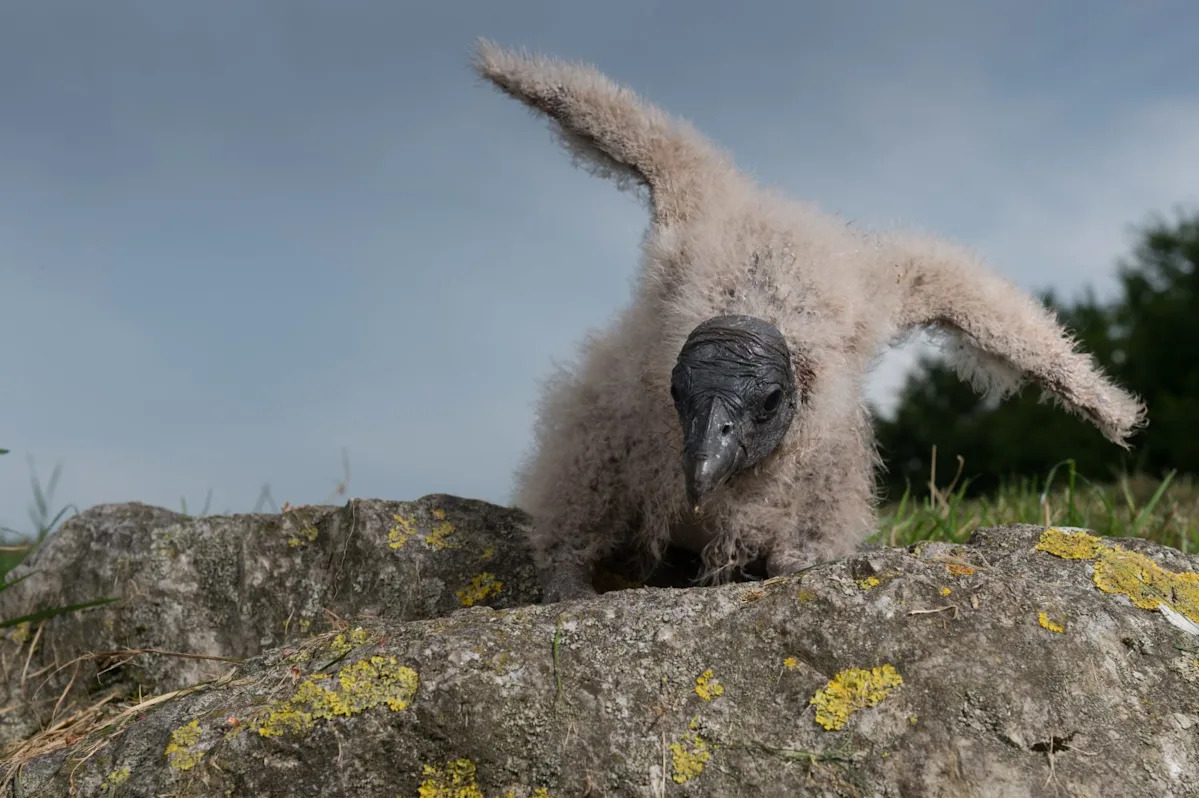
There is cause for celebration in Colombia. After 12 years of attempts, three Andean condor babies have been successfully hatched via artificial incubation. Each hatchling is healthy and has a healthy fear of people, both of which are positive when raising these condors in captivity.
Rafiki, Wayra, and Ámbar, similar to this Andean condor hatchling, were born via artificial incubation in Colombia.
©Leeloona/Shutterstock.com
(Leeloona/Shutterstock.com)
The babies, Rafiki, Wayra, and Ámbar, were hatched in July 2024, September 2025, and October 2025, respectively. Rafiki and Wayra are preparing to be released in 2026 and begin their lives in the wild. Given that Ámbar is a bit younger, it is not clear how much longer the condor will spend in captivity.
The births of these birds are a big step toward keeping the species from going extinct. With so few remaining in South America and one country previously declaring the condors extinct, the conservation of Andean condors is a top priority.
Andean Condors Are a Threatened Species
Andean condors were once widespread across South America. Unfortunately, that changed when they were no longer revered but instead treated like pests and threats to livestock. Despite being protected by the Endangered Species Act of 1973, the condor population continued to decline well into the 1980s. The biggest threats the Andean condors faced then and still face today include:
Intentional poisoning of the birds via laced carrion
Ingestion of lead bullets
Andean condors are sought out by hunters who shoot them for sport
Ingestion of DDT when used as a pesticide
Loss of large mammals that Andean condors fed on after they died

Andean condors were once hunted and poisoned to the brink of extinction.
©Roman Tovar/Shutterstock.com
(Roman Tovar/Shutterstock.com)
The populations of Andean condors vary by country. In Venezuela, where the birds were considered extinct in the past, fewer than 20 remain in the population today. Other countries are not far behind, with their populations being classified as either vulnerable to extinction or critically endangered. The number of each South American country with Andean condor populations is as follows:
Country | Population | Status |
Argentina | 1,500 | Vulnerable |
Bolivia | 1,388 | Vulnerable |
Chile | 1,500 | Vulnerable |
Colombia | 130 | Critically endangered |
Ecuador | 94 to 102 | Critically endangered |
Peru | 301 | Vulnerable |
Venezuela | Unclear if there are small populations or if birds are transient. If in the country, populations are no more than 20. | Nearly extinct |
Thanks to conservation efforts, some of these populations are growing, with the most success achieved through artificial incubation programs in various countries across South America.
Why Conservationists Are Using Artificial Incubation to Save the Andean Condor
With Andean condor populations dropping to very low levels, conservationists knew that if they did not step in, the condors would go extinct in more South American countries as they had in Venezuela. Consequently, artificial incubation was developed to help more eggs survive and eventually become hatchlings. Artificial incubation of Andean condor eggs was first successful in Argentina in 1991. The incubation proved to be a huge success in bolstering the condor population. As a result, other South American countries followed suit.

Andean condor eggs are being artificially incubated to help increase the species’ population.
©Regina Hoenes/Shutterstock.com
(Regina Hoenes/Shutterstock.com)
In Colombia, specifically, the Andean condor eggs that were laid in captivity were placed in incubators because parents were accidentally stepping on and cracking the eggs. With chicks being raised every two to three years, this was devastating to rebuilding the condor population.
Researchers also found that when they removed eggs from the nest, Andean condor pairs were more likely to lay additional eggs. This meant more eggs could be hatched, and the population numbers could increase at a much higher rate. Therefore, removing eggs from captive condors became the standard practice in Colombia. Success did not happen overnight, however. It took 12 years of incubating eggs for Rafiki to be born, officially becoming the first Andean condor to hatch via incubation in captivity in the country.
What Happens to the Chicks After They Are Hatched?
Once the eggs have hatched, caretakers go to great lengths to ensure that the Andean condor hatchlings do not bond with them. Instead, the condor babies are fed by artificial condor adults they come to rely on for food.
Caregivers use a puppet to feed the hatchlings. This ensures they do not see people as a food source when introduced to their wild habitats. It also makes it easier for young condors to transition from being fed by the puppet to consuming carrion on their own, rather than being fed by a human hand. Younger condors will also look to other condors in captivity when it is time to learn to fly. The more interaction there is with other Andean condors, the better the chances of survival when the captive condors are released.
The goal is to keep the condors at their higher elevations, where they have traditionally lived, before they nearly went extinct in some regions of South America. This is why controlled environments have been created to help young condors transition from captivity to a more natural habitat.
A healthy fear of people is what will ultimately keep the Andean condors alive. They will not seek out people for food, will stay away from telephone lines and cars, which have caused injury and/or death, and will remain in habitats that are safe for the condors, in hopes that they will reach a healthy, old age.
How Were the Condor Chicks Prepared for Life in the Wild?
There is no time when animal caretakers come into direct contact with any of the condors in their care. This is done so that the condors have a natural fear of people. The more fear there is, the less likely the Andean condors are to rely on people for their survival, and the better the chances the birds have of making it to an old age.
What the younger condors learn from the more mature ones they are housed with before being released is a hierarchy. By understanding this foundation, the condors will understand the pecking order in the wild and where they rank in feeding and mating.

Andean condors are raised around other condors to learn the skills needed to survive in the wild.
©Leeloona/Shutterstock.com
(Leeloona/Shutterstock.com)
While the mating aspect is not practiced in captivity for younger birds, feeding on carrion is. As the younger birds learn to navigate and feed themselves, they are carefully watched. This ensures that when released into a controlled environment and later into a habitat that is not, the Andean condors will be able to find and consume carrion, just as their wild-born counterparts do.
The young birds are given all the tools to survive in hopes they can make it through the tough adolescent stage, when the majority of Andean condors perish. By reaching adulthood, the condors have a good chance of living several decades, if not longer, helping the population increase over time.
What Do the Three Hatchlings Mean for the Survival of the Andean Condor?
The status of the Andean condor varies depending on which South American country is considered. From threatened to locally extinct, the condor populations are on the brink of collapse. This is why raising hatchlings in captivity and releasing them into the wild is cause for celebration.

In Colombia, the birth of the three Andean condor hatchlings has increased the population by 4.5%.
©VIDEOLIFT/Shutterstock.com
(VIDEOLIFT/Shutterstock.com)
In Colombia, there are 150 Andean condors left in the wild. With Rafiki, Wayra, and Ámbar being born, the population has increased by 4.5%. This is why the trio is being called the “salvation of the species.” While Rafiki and Wayra are old enough to be released in 2026, Ámbar still needs to mature further, having been born only in October 2025.
As the older birds are released in the mountains of Colombia, where there was once fear of the condors, they are now celebrated. There is an understanding of why conservation is necessary and what will happen to the ecosystem if the birds go extinct.
Locals Are Participating in Conservation
In the past, sheepherders in Cerrito, Colombia, located just outside of Bogotá, saw the Andean condors as pests. They were viewed as a threat to both the sheep herd and, therefore, to the pocketbooks of those caring for them. Try as they might, conservationists could not convince Colombians that the condors were not the ones attacking the sheep. This led to the continuation of the condors being poisoned or shot. Consequently, they moved to video proof that could not be refuted.
Beginning in 2018, the Jaime Duque Park Foundation began educating locals about why Andean condors were important to the ecosystem’s health. Additionally, camera-trap videos from traps placed by Colombians were reviewed. What it showed was that the condors were not the animals responsible for the sheep’s deaths. Instead, it was ocelots, foxes, and even the sheepherders’ own protection dogs.

The Andean condor is no longer seen as a pest in Colombia, but as an ally in the country’s development.
©Gus Martinie/Shutterstock.com
(Gus Martinie/Shutterstock.com)
However, there was also some truth to what the sheepherders said about Andean condors targeting sheep. The condors would target young lambs when carrion was unavailable, and they were starving. To combat this, locals began to place carrion on high perches, away from where the sheep grazed. They have also reduced grazing areas to deter Andean condors and restore some of their lost habitat.
Now, those living in Cerrito cannot imagine life without the condors, according to Mongabay. Since the conservation program began, the condor population has increased, and so has tourism to Cerrito. The condors are now seen as a benefit to the local community rather than a threat. This means the days of targeting Andean condors are gone. Instead, the condors are welcomed with arms wide open. Each new condor released from the Jaime Duque Park Foundation is celebrated, with Colombians doing what they can to ensure the Andean condors survive rather than go extinct locally, as they have in the past in other parts of South America.
The post Why the Birth of Three Andean Condors Represents a Second Chance for the Species appeared first on A-Z Animals.
